






|
This is a non-WLC article. When using resources from outside authors, we only publish the content that is 100% in harmony with the Bible and WLC current biblical beliefs. So such articles can be treated as if coming directly from WLC. We have been greatly blessed by the ministry of many servants of Yahuwah. But we do not advise our members to explore other works by these authors. Such works, we have excluded from publications because they contain errors. Sadly, we have yet to find a ministry that is error-free. If you are shocked by some non-WLC published content [articles/episodes], keep in mind Proverbs 4:18. Our understanding of His truth is evolving, as more light is shed on our pathway. We cherish truth more than life, and seek it wherever it may be found. |
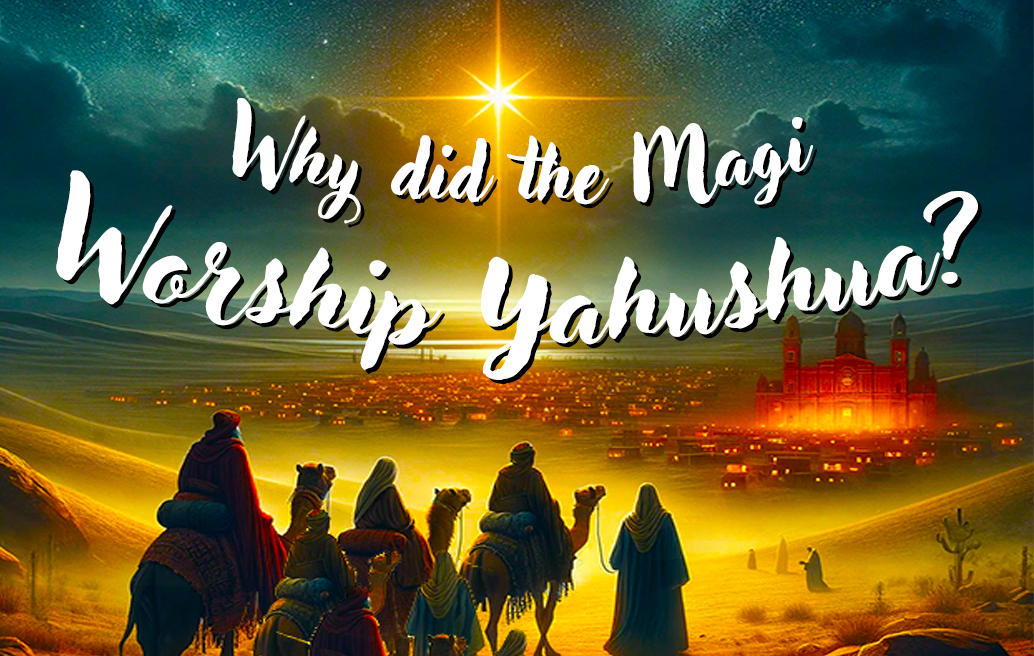
Some use a handful of New Testament passages regarding the worship of Yahushua to support the notion that Yahushua is Yahuwah. They reason that only Yahuwah can receive worship. Therefore, Yahushua must be Yahuwah. The first of these texts is found in the gospel of Matthew:
Matthew 2:1-2 and 11 Now after Yahushua was born in Bethlehem of Judea in the days of Herod the king, magi from the east arrived in Jerusalem, saying, 2 “Where is He who has been born King of the Jews? For we saw His star in the east and have come to worship Him.” …11 After coming into the house they saw the Child with Mary His mother; and they fell to the ground and worshipped Him. Then, opening their treasures, they presented to Him gifts of gold, frankincense, and myrrh.
Magi is the plural form of the Greek mágos. The term describes a caste of wise men from the Orient trained in astronomy, astrology, and natural science.1 Some believe the magi were a part of the cast of magicians and wise men who served alongside Daniel during the reign of King Nebuchadnezzar. The Septuagint2 uses the same Greek word mági3, to describe these men that Matthew uses to describe the magi in his narrative. Scholars believe it is likely that the magi of Yahushua’s day would have been familiar with Daniel’s prophecy regarding the Son of Man.4 In this messianic vision, Daniel saw a man presented before the Ancient of Days and given dominion, glory, and an everlasting kingdom that all people and nations might serve him.5 This may have been the prophecy that motivated the magi to travel to Jerusalem for the young king.
Who Did The Magi Come to Worship?
Neither the Jewish leaders, King Herod, nor the magi thought the Messiah was a deity. Instead, according to Daniel and Micah, they understood that the Messiah would be a man born in Bethlehem, commissioned to rule on Yahuwah’s behalf.
|

What was the reason the magi gave King Herod for traveling to Jerusalem? According to the text, they came to worship the King of the Jews. Nowhere does the text state that the magi believed Yahushua to be Yahuwah. There is no mention of Yahushua’s supposed deity in the entire passage.6 When Herod learned of their search, he asked the chief priests and scribes where the Messiah was to be born.7 The Jewish leaders responded by quoting the prophet Micah, who foretold that the Messiah would be born in Bethlehem. King Herod then told the magi that when they located the child king, they should report it to him so that he, too, might worship him. But Herod did not indicate that he thought the child the magi were searching for was Yahuwah. On the contrary, his later murderous actions revealed he thought the Messiah was mortal.8
The traditional Jews of the first century were monotheistic. Their God had declared that He alone was God.9 Neither the Jewish leaders, King Herod, nor the magi thought the Messiah was a deity. Instead, according to Daniel and Micah, they understood that the Messiah would be a man born in Bethlehem, commissioned to rule on Yahuwah’s behalf.10
Even though the text says nothing about the wise men worshiping Yahushua as Yahuwah, why do many Christians interpret it as proof that Yahushua is a deity? The answer is simply because the word worship is used for Yahushua, and since Yahuwah said we were to worship only Him, Yahushua must be Yahuwah. This reasoning reveals a misunderstanding of the word worship in the New Testament.
Proskuneô
The word worship in Matthew 2 is the Greek word proskuneô, which comes from the words prós, which means toward, and kyneo, which means to kiss or adore. According to The Complete Word Study Dictionary, proskuneô means:
To worship, do obeisance, show respect, fall or prostrate before. Literally, to kiss toward someone, to throw a kiss in a token of respect or homage. The ancient oriental (especially Persian) mode of salutation between persons of equal ranks was to kiss each other on the lips; when the difference of rank was slight, they kissed each other on the cheek; when one was much inferior, he fell upon his knees and touched his forehead to the ground or prostrated himself, throwing kisses at the same time toward the superior. It is this latter mode of salutation that the Greek writers express by proskuneo. In the NT, generally, to do reverence or homage to someone, usually by kneeling or prostrating oneself before him.11
Contrary to popular belief, worship, or proskuneô, is not reserved for Yahuwah alone. Scripture records instances where worship is offered to men.
|
Contrary to popular belief, worship, or proskuneô, is not reserved for Yahuwah alone. Scripture records instances where worship is offered to men.12 For example, Yahushua told a parable about a king who wanted to settle accounts with his servants. When one servant, who owed the king ten thousand talents was brought before his master, he fell down and worshipped him:
Matthew 18:24-27 (KJV) And when he had begun to reckon, one was brought unto him, which owed him ten thousand talents. 25 But forasmuch as he had not to pay, his lord commanded him to be sold, and his wife, and children, and all that he had, and payment to be made. 26 The servant therefore fell down, and worshipped him, saying, Lord, have patience with me, and I will pay thee all. 27 Then the lord of that servant was moved with compassion, and loosed him, and forgave him the debt.
The word worshipped here is proskuneô, the same word used to describe the reverence the magi showed Yahushua. The servant was not paying homage to Yahuwah but to his master, the king.
Another example where worship is offered to man is found in Revelation. Yahushua comforted faithful followers in Philadelphia who were experiencing persecution by telling them that he would make their enemies worship before them:
Revelation 3:9 (KJV) Behold, I will make them of the synagogue of Satan, which say they are Jews, and are not, but do lie; behold, I will make them to come and worship before thy feet, and to know that I have loved thee.
Again, worship here is the word proskuneô. Yahushua said he would make evil men worship those who had remained faithful. By doing so, Yahushua is not going to elevate believers to the realm of deity, rather he is going to force their enemies to acknowledge their worthiness.
Unfortunately, modern versions deviate from translating proskuneô as worship when it applies to men, choosing instead to render it bow down or some other similar phrase. This distinction, which the text does not make, serves to support the post-Biblical notion that Yahushua is Yahuwah. One author addresses the incongruity in later translations this way:
When the King James Bible was written, “worship” could be used to describe both exhibiting reverence for Yahuwah and prostrating oneself.
|
When the King James Bible was written, “worship” could be used to describe both exhibiting reverence for Yahuwah and prostrating oneself. While not perfect, it’s a decent translation [of proskuneô]. As a result, throughout the King James Bible, people “worship” many things. A slave worships his owner, the assembled of Satan worship an angel, and Roman soldiers mocking Yahushua worship him. In each of these instances, the word does not mean “praise Yahuwah’s glory” or anything like that; instead, it means to bow or prostrate oneself. But English Bibles adopted later—the New International Bible, the New American Standard Bible, the Living Bible and so on—dropped the word worship when it referenced anyone other than Yahuwah or Yahushua. And so each time προσκυνέω [proskuneô] appeared in the Greek manuscript regarding Yahushua, in these newer Bibles he is worshipped, but when applied to someone else, the exact same word is translated as “bow” or something similar. By translating the same word different ways, these modern Bibles are adding a bit of linguistic support to the idea that the people who knew Yahushua understood him to be Yahuwah. In other words, with a little translational trickery, a fundamental tenet of Christianity—that Yahushua is Yahuwah—was reinforced in the Bible, even in places where it directly contradicts the rest of the verse.13
Hence the confusion with passages such as Matthew 2, Matthew 14 , and John 9 where the text speaks of worshiping Yahushua. Instead of allowing the continuity of the language to remain intact throughout the New Testament, translators obscure the Biblical meaning of proskuneô by imposing their bias on selected texts in order to lend support to a post-Biblical view of Yahushua.Scripture instructs us to worship Yahuwah, that is, to revere, pay homage, and acknowledge His superiority because He is God. But the same act offered to a man who is deemed worthy is quite acceptable as long as he is not being worshipped as God.
If Scripture is the arbiter of true doctrine, we cannot use the magi’s worship of Yahushua as proof that he is Yahuwah. The context reveals that the wise men worshipped Yahushua because he was the prophesied Messiah, the one designated by Yahuwah to rule on His behalf, not because they thought he was Yahuwah incarnate.
1 Matthew 2:1 translation note, NASB Study Bible, Kenneth Barker, ed., (Grand Rapids, MI: Zondervan, 1999), p. 1366.
2 The Septuagint is the earliest extant Greek translation of the Hebrew Old Testament.
4 For example, John MacArthur says, “Because of Daniel’s high position and great respect among them, it seems certain that the magi learned much from that prophet about the one true God, the God of Israel, and about His will and plans for His people through the coming glorious King. Because many Jews remained in Babylon after the Exile and intermarried with the people of the east, it is likely that Jewish messianic influence remained strong in that region even until New Testament times.” Grace to You, 9-11-20, accessed 1-19-21, https://www.gty.org/library/bibleqnas-library/QA0251/how-did-the-magi-know-about-Yahushua
6 Matthew 2:1-12.
7 Matthew 2:3-4.
8 Matthew 2:5-8 and 12-18.
9 Isaiah 44:6; 44:55; 45:21, etc.
10 Daniel 7:13-14; Micah 5:2-4.
11 The Complete Word Dictionary, New Testament, Spiros Zodhiates, ed., (Chattanooga, TN: AMG Publishers, 1993), p. 1233-34.
12 Ibid.
13 Kurt Eichenwald, The Bible: Its So Misunderstood It’s a Sin, 12-23-14, accessed 1-19-21, http://www.newsweek.com/2015/01/02/thats-not-what-bible-says-294018.html
This is a non-WLC article. Source: https://oneGodworship.com/why-did-the-magi-worship-Jesus/
We have replaced the English titles and names of the Father and the Son with those employed by the apostles. In the scriptural quotations provided, we have restored their original names as used by the inspired writers. Nevertheless, we acknowledge the historical development by which the name Yahushua came to be rendered as “Jesus.” Additionally, we recognize that the English term “God” has been commonly employed as an equivalent for the Hebrew Eloah or Elohim. -WLC Team